

How to Find Cheap Stocks in the Stock Market: 2026 Version. Part 1
Welcome! (Content 100% made by a human)
This is the guide I wish I had read back in 2013. When I started to understand that there could be a path for the less fortunate, yet consistent and hard-working, to have their place in the sun. Of course, each journey is unique. But I thought a lot about writing a no-nonsense guide on how to find cheap stocks on the stock market.
When I started investing, I began with stocks, had some Treasury titles, forex, US stocks, and finally reached Bitcoin. It’s been a 12-year road. Today, I want to teach you how to find undervalued assets not only on the Bovespa, but anywhere, using only logic and common sense.
Economic Laws
Interest Rate Policy
Imagine that money is like a very cool toy you don’t have at home, but really want to play with. To get this toy, you need to borrow it from a “Giant Toy Store” (which is the Bank).
But there’s a catch: to take the toy home, you need to give some candy in exchange for the time you keep it. These candies are the interest.
Interest Rate Policy is when the “Store Owner” decides whether to charge many candies or few candies. It works like this:
1. When Interest is HIGH (Many candies)
The Store Owner says: “To take this toy, you have to give me 10 candies!”.
- What happens: You think: “Wow, 10 candies is a lot! Better if I stay without the toy and keep my candies in my little jar”.
- In real life: People stop borrowing money to buy cars, houses, or open stores. Money stays “tucked away” and the prices of things stop rising quickly (this helps control Inflation).
2. When Interest is LOW (Few candies)
The Store Owner says: “Today it’s cheap! You can take the toy for only 1 candy”.
- What happens: You and all your friends run to the store! Everyone wants to borrow the toy because it’s easy to pay later.
- In real life: People take money to build factories, buy things, and create jobs. The economy gets super busy and everyone spends more.
Why does the “Store Owner” change the price?
The Central Bank (the big boss of the economy) works like an air conditioning thermostat:
- If the economy is “too hot” (prices are rising too fast and everything is becoming a mess), it increases interest rates to cool things down.
- If the economy is “cold” (no one buys anything and stores are closing), it lowers interest rates to warm up the market and get people circulating money again.
Summary: Interest rate policy is how the government controls whether people should spend money now or save it for later!
Sector Rotation
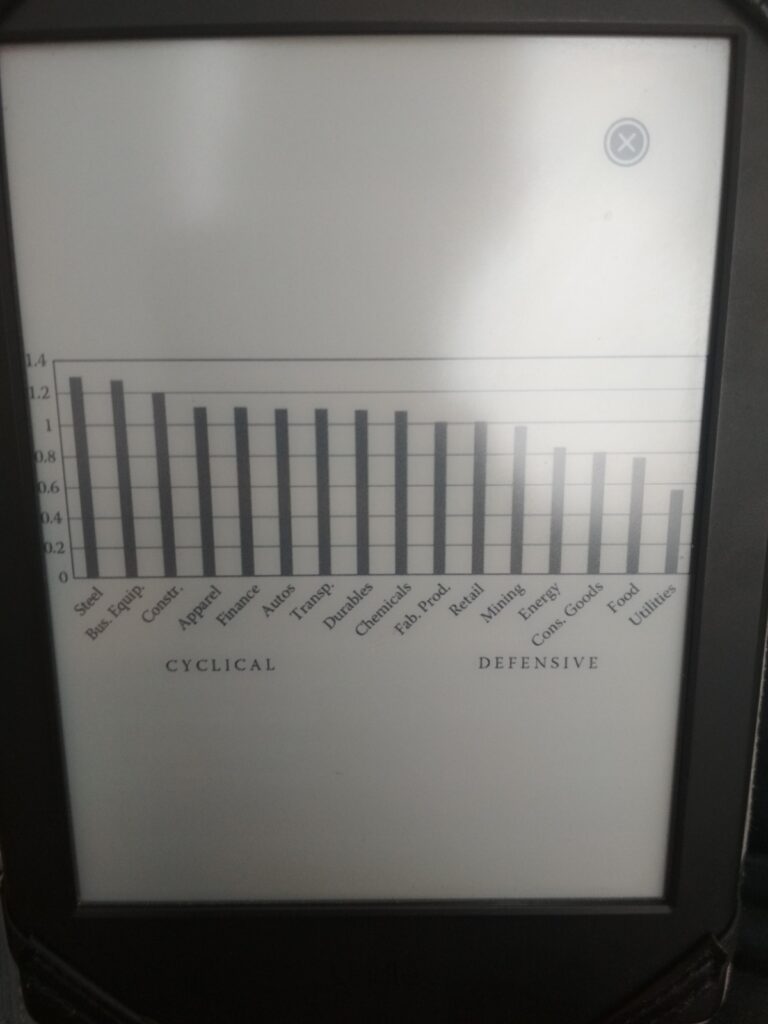
Along with this interest rate policy, some events are triggered, benefiting some sectors and harming others. The big trick is to understand beforehand which sectors will benefit from a certain interest rate policy.
However, I want to remind you that something must be tattooed in your minds:
| Interest Rate Policy | Stocks | Bonds | Commodities | Cryptocurrencies |
| High Interest | Wait | Buy | Wait | Wait |
| Low Interest | Buy | Wait | Buy | Buy |
Qualitative Analysis
When we talk about qualitative analysis, in direct terms, we want to refer to the quality of the products/services the company offers. In this phase, you have to think like a consumer. Why do you prefer Coca Cola over Pepsi? Why do you prefer iOS over Android? Why do you prefer to travel with Gol or Azul? What does the company do?
In what market does the company operate? Who are its commercial partners? How is it positioned in the market? If possible, consume the company’s products and services. Test them and draw your own conclusions.
In this phase, a SWOT analysis can also be done.
Quantitative Analysis
In this phase, we are going to demystify all those terms and jargons that “Faria Limers1” love so much. You don’t need a PhD or a master’s degree to invest your hard-earned money. Understanding some concepts will already help you move forward.
Let’s start with something I consider vital: Reading. If you are really embarking on this journey, you must become a continuous learner, a devourer of books, a wise person from so much reading and reflection.
This is the list of books I recommend everyone read:
- The Most Important Thing: Uncommon Sense for the Thoughtful Investor – Howard Marks
- Your Complete Guide to Factor-Based Investing – Andrew L. Berkin and Larry E. Swedroe
- Quantitative Value Investing in Europe – Nils-Christian S. Jørgensen
- Invest with the Fed – Robert R. Johnson et al.
- Dual Momentum Investing – Gary Antonacci
- Short Term Trading Strategies That Work – Larry Connors and Cesar Alvarez
The point here is simple! Reading = Knowledge = Experience = Shortening the learning curve. Another thing we shouldn’t even be discussing here, but it’s still important to emphasize: English!

P/B – Price-to-Book Ratio
This is an important metric because it measures the stock price divided by the book value. It informs how much the market is willing to pay for the company’s net equity. That is, every time this number equals 1, the price is “fair“. It is cheap whenever it is less than 1. Above 1, it is overvalued for some reason.
I like this metric very much because it proves the irrationality of the crowd. Often we have an asset that is worth it, yet at that moment, the market judges it as bad. Which makes it undervalued.
Net Profit
I shouldn’t even have to explain this one. We are in globalized capitalism, and it’s obvious that sooner or later, the business needs to pay bills, end up positive, and pay shareholders returns in dividends and/or stock price (which I prefer!). No matter how much your favorite CEO takes the stage in an expensive suit and speaks Portuguese mixed with English, you need to demand the most important thing from him in this economic system: Profit!
I’m talking about real net profit. Not gross profit and all those technical terms they keep spitting out. The big exception comes from technology companies; it’s worth mentioning that companies like Uber, Tesla and Airbnb took a long time to become profitable. However, once they did, they never looked back.
5-Year Revenue Growth
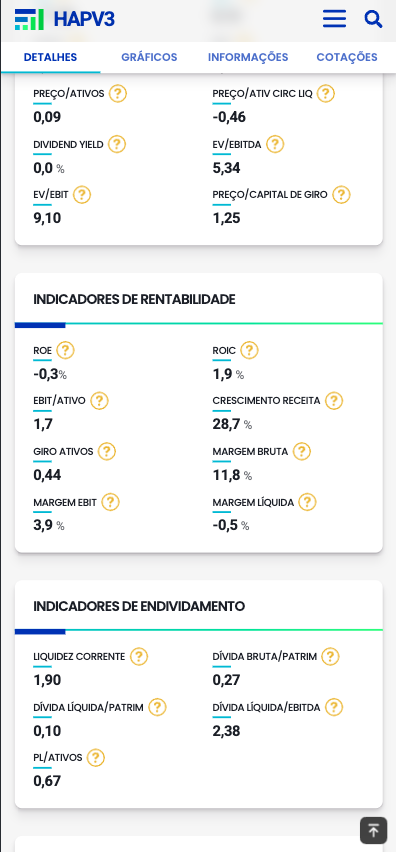
Revenue growth is an important metric to check the health of the company’s revenue. Every company that aims to become financially healthy must keep its revenue growing; otherwise, there will be contraction. The minimum 5-year revenue growth rate we look for is around 15%. In other words, in five years, the company must be able to increase its revenue by at least 3% per year. Doing this consistently can make it a “cannon” in the future.
Net Debt to EBITDA
Okay, but what is this EBITDA crap?
Earnings before interest, taxes, depreciation and amortization or EBITDA is a term widely used by financial analysts in the analysis of accounting balance sheets of public companies.
A company with debt at 30% of its equity is already in difficulty, with rare exceptions… Because in an eventual bankruptcy, 30% of the equity will already be lost to amortize debts.
Technical Analysis
Technical analysis is nothing more than the graphical study of the behavior of the crowd. When analyzing a chart, you are looking at two pieces of information: the past and the behavior of the people. One thing you will learn over time is that most of the time, the crowd is wrong. And wrong badly…
Price is just information. Of how much people are willing to pay at that moment for that particular asset. Most of the time, the crowd is wrong. They fail because they don’t study properly, because they don’t have access to platforms like Bloomberg and others. So it’s basically a coin flip.
What do the charts tell you?
In the short term, charts go wherever they want. It’s purely irrational! A long term, they follow value! If you reverse the thinking: Is any of these companies really going to break? This shows how unprepared we are and how little we know about the companies we have right here in Brazil.
In 2008, Cesar Alvarez and Larry Connors made a 100% return operating on the long side. You didn’t read that wrong! They operated in short periods of time (2 days to 2 weeks). Several quantitative studies by the duo showed that working on the side in favor of the trend is the best way to be profitable in the short/medium term within the stock market.
Keep things simple!
Sentiment Analysis
How to measure public attention for investment?
WTF??? I know, I know. It sounds like all that talk everyone preaches. In this phase here, we are going to measure if it’s “hot or cold“.
Google Trends
Google Page 1
A good first way to measure if the asset you want to trade has demand is simply by looking at page number one of Google search. It works like this: you type the asset ticker and analyze what people are talking about, what they are asking, the amount of videos and articles written.
This is by far my favorite social network. A combination of a forum with the fruit salad available on the internet (AKA: Shorts, Games, Images, Text, and longer Videos).
End of the First Part
This was the first article on the subject. I will write another to complement it, after all. If you made it this far, you read more than 3,000 words. To avoid being bureaucratic, we decided to break the text into two parts. Take the chance and sign up for our newsletter at the top of the menu while part two comes out.
Disclaimer
Nothing I write here is an investment recommendation or a call to buy and sell. Draw your own conclusions and see what is best for you. Past results are no guarantee of future results. Take care of your money, because no one will do it for you.
- People in suits or wearing the famous vest, who fly helicopters and speak a thousand terms in English-Portuguese. ↩︎

I started investing in 2014, my first stock was ABEV3 (R$50). I’ve worked with forex, futures, crypto, and derivatives. Here, I share ideas in a relaxed way.