

USIM3: Is It Worth Buying Usiminas Shares at a Historic Discount?
The national steel industry is one of the pillars of Brazilian economic development, and at the center of this sector is Usiminas. Investors looking for value opportunities often find the ticker USIM3 shining on their home broker. But are Usiminas shares actually cheap, or are we facing a value trap? Understanding the operational behavior and structure of this giant is the first step before allocating your hard-earned capital.

In this comprehensive, encyclopedic guide, we deeply analyze the fundamental indicators, operational risks, the technical behavior of the shares, and the company’s valuation, providing everything you need to know to decide if buying USIM3 makes sense for your portfolio.
Who is Usiminas and what does it do?
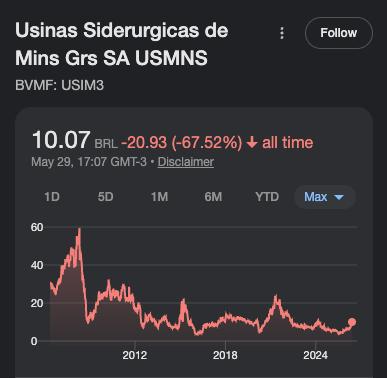
Founded in 1956 under the name Usinas Siderúrgicas de Minas Gerais S.A., Usiminas officially began its operations in 1962 in the city of Ipatinga, Minas Gerais. It is one of the largest producers of flat steel in Latin America, operating from end to end in the value chain: from iron ore extraction to steel transformation and the final distribution of high-value-added finished products.
The company serves critical base industries, providing steel to car manufacturers, home appliance producers (white goods), civil builders, and oil and gas pipeline manufacturers. The group’s structure includes the main plant in Ipatinga (MG), the Cubatão plant (SP), in addition to the subsidiary Mineração Usiminas (Musa) and Soluções Usiminas, the logistics and steel distribution branch.
Key People of the Operation
The operational efficiency and strategic direction of a steel mill depend on the management team behind its board. At Usiminas, governance is historically marked by the union of heavy controlling blocks such as Ternium/Tenaris and Nippon Steel.
- Marcelo Chara (CEO): Took command bringing international experience from the Techint/Ternium group. His management is focused on cost efficiency, industrial process rationalization, and margin recovery after massive investment in the thermal refining of Brazilian plants.
- Thiago da Portilla Rodrigues (CFO): Responsible for calibrating the company’s capital structure, securing the necessary liquidity for heavy investments, and keeping debt under control.
- Alberto Ono (Board Member and Former CEO): Played a vital role in structuring the company’s finances and managing the smooth transition of operational control, now serving on the strategic governance guidelines.
Analysis Session of Usiminas
Quantitative Analysis
Usiminas’ numbers reflect a purely cyclical business. The company’s net revenue fluctuates according to international prices for steel and iron ore. Currently, the company presents indicators that draw the attention of value investors focused on book value discounts.
- P/B (Price-to-Book Value): Hovers around 0.58x. Buying Usiminas today means paying R$ 0.58 for each R$ 1.00 of the company’s accounting net equity, denoting an attractive margin of safety.
- P/E (Price-to-Earnings): This indicator has operated at atypical levels due to recent balance adjustments and temporary losses resulting from the shutdown and renovation of Blast Furnace 3 in Ipatinga, which cost billions of reais. Normalizing these earnings projects a prospective single-digit mid P/E.
- Dividend Yield: Historically fluctuates between 2% and 8%, depending on the cycle stage. In periods of high free cash flow generation, the company distributes generous payouts, though it should not be considered a purely linear dividend payer.
- Leverage: The Net Debt/EBITDA ratio is controlled, remaining at safe levels after the completion of the largest Capex modernization cycles.
The steel commodity market demands that management maintains a robust cash position to withstand the down periods of the steel cycle. Usiminas’ main operational cost comes from raw materials: iron ore and metallurgical coal. Partial self-sufficiency in iron ore through Musa alleviates margins, but coal, being imported, exposes the balance sheet to dollar currency variations.
/
Qualitative Analysis
In the non-numerical aspect, Usiminas’ main competitive advantage (moat) is its industrial and logistical barrier to entry. Building an integrated steel plant costs billions of dollars and requires decades of logistical development. Additionally, the Usiminas brand is synonymous with high-quality automotive flat steel, an extremely demanding sector where foreign competitors face difficulty in immediate penetration due to international freight costs.
The company’s corporate governance is listed in B3’s Level 1. Although historical conflicts between controllers Nippon Steel and Ternium weighed in the past, the recent corporate reorganization agreement pacified management, giving faster decision-making speeds to the board and improving market perception.
Technical Analysis
For the tactical investor looking for the ideal entry timing, analyzing the weekly chart using the indicators 200-period Exponential Moving Average (EMA200) and the 2-period Connors RSI (CRSI2) provides great clues.
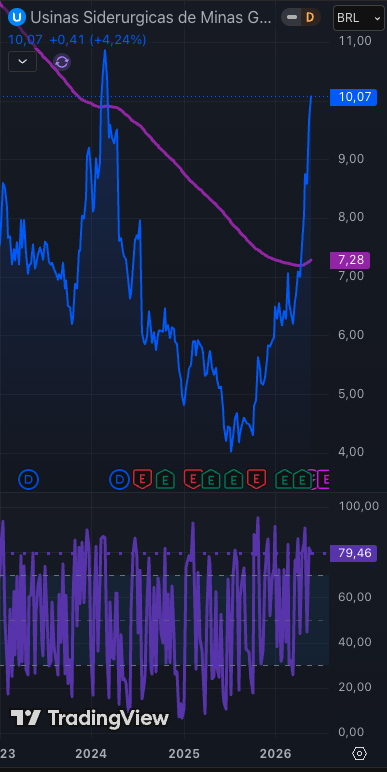
On the weekly chart of USIM3, the analysis follows the rule that we only act on the long side (buying).
- Trend Filter: The current price must be traded above the weekly EMA200 to confirm that the macro long-term trend is bullish.
- Trigger Entry (CRSI2): When the CRSI2 hits readings below 10 (ideally close to 0), it indicates that the asset is in an extreme short-term oversold zone within a larger uptrend. This is when market panic creates the perfect opportunity for position building.
- Exit Zone (CRSI2): CRSI2 readings above 80 or 90 represent short-term buying exhaustion and serve as an indication to pause buying or take partial profits.
SWOT Analysis
Below, we summarize the steelmaker’s strengths, weaknesses, opportunities, and threats in a practical table for easy visual understanding:
Here is the detailed SWOT Analysis chart for Usiminas (USIM3) in English:
| Strengths | Weaknesses |
|---|---|
| Domestic Market Leadership: Dominant position in supplying high-quality flat steel to the Brazilian automotive and white goods industries. Iron Ore Self-Sufficiency: The operation of Musa (Mineração Usiminas) provides partial cost control over its primary raw material. High Barriers to Entry: The integrated steelmaking sector requires billions of dollars in infrastructure investment (Capex) and logistics development, preventing new domestic competitors. | Cyclical Business Model: Margins and earnings are highly dependent on the global price cycles of steel and iron ore. Dependence on Imported Inputs: The necessity of importing metallurgical coal and other dollar-denominated inputs exposes the balance sheet to exchange rate fluctuations. High Maintenance Costs: Heavy industrial plants require expensive and complex maintenance shutdowns that can temporarily affect production and margins. |
| Opportunities | Threats |
| Post-Renovation Efficiency: The full operation of the newly modernized Blast Furnace 3 in Ipatinga is expected to reduce operational costs and increase production thermal efficiency. Anti-Dumping Measures: The implementation of government tariffs against foreign steel imports (particularly from China) protects the margins of domestic steelmakers. Infrastructure Projects: Possible acceleration of investments in infrastructure and housing in the domestic market, driving higher demand for flat steel. | Chinese Dumping: The massive influx of subsidized Chinese steel into the domestic market at predatory prices compresses the company’s profit margins. High Domestic Interest Rates: High interest rates (such as Selic) make credit more expensive, cooling down vehicle sales and the real estate sector—the largest consumers of steel. Global Economic Slowdown: An economic contraction in major global powers (such as the US and China) reduces the demand and prices of mineral commodities worldwide. |
The Verdict on Usiminas Shares
Analyzing Usiminas shares shows us a classic value asset with a historic book value discount. The P/B ratio at 0.58x demonstrates that the market is pricing in a catastrophe scenario that might not materialize, especially with Blast Furnace 3 operating efficiently and stabilizing operational cash generation.
Before allocating capital in USIM3, investors need to consider their own time horizon. Steelmaking is not an investment for those seeking linear profits and total predictability every quarter, but rather for those who understand economic cycles and seek exponential returns by buying valuable assets at fire-sale prices.
If you want to receive deep financial analyses, straight to the point and without fluff, directly to your inbox, join the thousands of smart investors who subscribe to our free mailing list.
Frequently Asked Questions (FAQ)
Q: What is the difference between USIM3 and USIM5? R: USIM3 is an ordinary share (ON), which grants voting rights in the company’s shareholder meetings. On the other hand, USIM5 is a preferred class A share (PN), which has preference in receiving dividends and usually registers higher daily liquidity on the B3 exchange.
Q: Does Usiminas pay good dividends? R: Usiminas’ dividend payout follows the steel cycle. In years of peak demand and high steel prices, the company pays generous distributions. Conversely, during cycle lows or heavy infrastructure investments in furnaces, dividends are typically reduced or paused temporarily.
Q: Are Usiminas shares safe? R: Because it is a cyclical commodity company, share prices experience severe fluctuations in the equity market. The company has healthy finances and market leadership, which reduces insolvency risks, but investors must be prepared to handle the stock’s short-term volatility.
Q: How does the price of Chinese steel affect Usiminas? R: Subsidized Chinese steel often enters the global market at prices below domestic production costs. When dumping occurs in the Brazilian market, Usiminas is forced to lower its prices or lose sales volume, squeezing its operational margins.
Disclaimer and Risk Warning
The content of this detailed analysis is purely for educational and informative purposes, not configuring, under any circumstances, a recommendation to buy, sell, hold, or allocate any financial assets or securities. The equity market is inherently volatile and risky, subject to total or partial loss of invested capital. Investment decisions are the sole and exclusive responsibility of the reader. Past profitability performance serves as no guarantee of future operational returns.
References
- Usiminas Investor Relations Portal (ri.usiminas.com)
- Historical share prices and consolidated multiples of B3 (b3.com.br)
- Quarterly Production and Sales Reports from the Brazilian Securities and Exchange Commission (CVM)
- International price statistics for ferrous alloys and inputs (Trading Economics)

I started investing in 2014, my first stock was ABEV3 (R$50). I’ve worked with forex, futures, crypto, and derivatives. Here, I share ideas in a relaxed way.